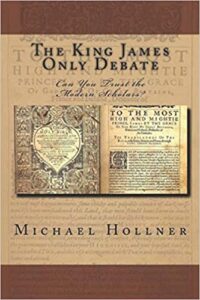
 (Read part 1). Part 2 will cover chapter 14, “The Septuagint Fallacy.” This is the title in the table of contents. As I pointed out in part 1, only three chapters have the same title as that listed in the table of contents. The title of chapter 14 is “The Real History of the Septuagint LXX: Do You Really Know What the LXX Septuagint Is?” Most recognized scholars believe that the Septuagint or LXX is the Greek translation of the Hebrew Old Testament that was quoted by Christ and the Apostles. The evidence for this is scant. There are some Greek fragments of the Pentateuch that have been dated, supposedly, to the first and second centuries B.C. And there are also some Greek fragments of the Minor Prophets that have been dated, supposedly, to the first century B.C. Relatively complete manuscripts of the LXX are Codex Vaticanus and Codex Alexandrinus. Incomplete manuscripts of the LXX are Codex Ephraemi Rescriptus and Codex Sinaiticus.
Hollner’s overall thesis of this chapter that the LXX is a fraud is sound. However, much of what is found in the chapter is not. The word “Apocrypha” is only capitalized once. Codex Ephraemi Rescriptus is not mentioned. Wikipedia is cited as a source.The Apocrypha is referred to as “it” and “them” in the same sentence, and is elsewhere called a “reading.” The Apocrypha was not “later removed in all KJV reprints.” That some modern scholars accept the Apocrypha as Scripture does not make it true that it “is nowhere accepted as Scripture except by modern scholarship and the Roman Catholic Church.” And these are just the errors in the first paragraph on page 418.
The errors in the rest of the chapter are legion. Words are capitalized that should not be, and words that should be capitalized are not. Book titles are not put in italics. Words are unnecessarily put in italics. Parentheses are not used where they should be. En dashes are used for Em dashes. Apostrophes are used incorrectly. The quote by the unidentified Scott Jones on page 425 has no close quote mark so there is no way to determine where it ends. Hollner misinterprets his quote from Josephus (p. 433).
The term “Masoretes” and “Masoretic Text” should never be applied to anything before the time of Christ. No one claims that “the 7th-10th century Masoretes somehow created a new ‘Masoretic’ text” (p. 419). The first Hebrew Bible (OT) to be printed was in 1488 at Soncino, Italy, not in 1477. It is an overstatement to say that “there is more evidence for a ‘Tooth Fairy’ than there is for a B.C. Greek Septuagint” (p. 420). Hollner assumes his readers will know that “Brenton” is a reference to the edition of the LXX by Sir Lancelot C. L. Brenton. This is called both “Vaticanus/Sinaiticus” and “Vaticanus” (p. 424). Gerhard Kittel (1888-1948), the German Lutheran theologian and lexicographer at the University of Tübingen and editor of the Theological Dictionary of the New Testament did not produce “a corrupted Hebrew text” (p. 421). It was his father, Rudolf Kittel (1853-1929), an Old Testament scholar and professor at Breslau and Leipzig, who edited a critical edition of the the Hebrew Bible titled Biblia Hebraica. Hollner says that the Biblia Hebraica 1937 edition had 30,000 changes from “the true Masoretic text,” but then goes on to say that its footnotes “suggest from 20,000 to 30,000 changes throughout the whole Old Testament” (p. 421). The Leningrad Codex is not “corrupt,” and is an edition of the Masoretic Text (p. 421). Although Hollner claims that “many words are missing” (p. 421), he doesn’t give any examples. The Biblia Hebraica Stuttgartensia (Hollner’s “Stuttgart edition” of 1966-1967) was issued in fascicles from 1968 to 1976, and published in one volume in 1977. Stay tuned for the third installment.
 As I have said from the beginning of The Preacher’s Library, this is not a book review blog. I have written scores of book reviews, and hope to eventually have them all posted at The Preacher’s Library
 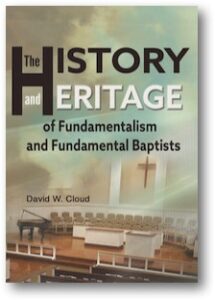 If you are looking for a book by an Independent Fundamental Baptist that “contains an extensive history of Fundamentalism in general and of fundamental Baptists in particular,” I recommend The History and Heritage of Fundamentalism and Fundamental Baptists (Way of Life, 2020), by David W. Cloud. The main sections of the book are 1. Interdenominational Fundamentalism, 2. Metropolitan Tabernacle, London, 3. Northern Fundamental Baptists, 4. Southern Fundamental Baptists, 5. Where Are Fundamental Baptists Today?, 6. New Testament Churches in the Last Days. The book is not on Amazon, but can be ordered from Way of Life Literature, www.wayoflife.org.
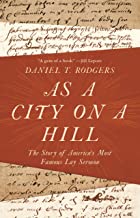 We have all heard America described as a city on a hill. The phrase comes from John Winthrop’s (1588-1649) “A Model of Christian Charity.” It is based on Matthew 5:14: “Ye are the light of the world. A city that is set on an hill cannot be hid.” If you have the time to do any reading in early American religious history, As a City on a Hill: The Story of America’s Most Famous Lay Sermon (Princeton, 2018) is a good supplement to whatever text you are reading.
 I have many unusual and relatively unknown books in my library that are extremely valuable. Two examples are: Discovering the End of Time: Irish Evangelicals in the Age of Daniel O’Connell (McGill-Queen’s University Press, 2016), and Exporting the Rapture: John Nelson Darby and the Victorian Conquest of North-American Evangelicalism (Oxford, 2018), both by Donald Harman Akenson. We all know, or we should know, about
  years before the Scofield Reference Bible (not invented it as many of the Reformed falsely assert). Although there is much in these books about Darby and his teachings and writings, they primarily explore the religious and cultural environment in which Darby lived in Ireland. These books are absolutely essential for understanding the life and times of John Nelson Darby.