Someone asked me about middle knowledge after I made mention of the term in a recent post at The Preacher’s Library. I say on page 389 of my book The Other Side of Calvinism that middle knowledge is “knowledge of what will or could or would happen.” This is also called Molinism, after Luis de Molina (1535-1600), who taught that through God’s middle knowledge, “in virtue of the most profound and inscrutable comprehension of each faculty of free choice, He saw in His own essence what each such faculty would do with its innate freedom were it to be placed in this or in that or, indeed, in infinitely many orders of things—even though it would really be able, if its so willed, to do the opposite.”
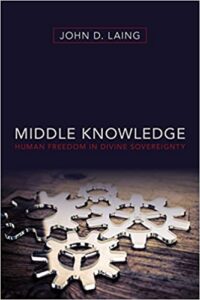 I was introduced to the term via William Lane Craig’s The Only Wise God: The Compatibility of Divine Foreknowledge and Human Freedom (Baker, 1987). The more recent and notable books on the subject of middle knowledge are, from a philosophical point of view, Molinism: The Contemporary Debate, edited by Ken Perszyk (Oxford, 2011). From the religious perspective there is Middle Knowledge: Human Freedom in Divine
  Sovereignty, by John D. Laing (Kregel, 2018). I recommend Luis de Molina: The Life and Theology of the Founder of Middle Knowledge, by Kirk R. MacGregor (Zondervan, 2018), and William Lane Craig’s contribution to Divine Foreknowledge: Four Views, edited by James Beilby and Paul R. Eddy (IVP Academic, 2001).
 John Goldingay is an Anglican Old Testament scholar, and is the David Allan Hubbard Professor Emertius of Old Testament at Fuller Theological Seminary. I have his new commentary on Genesis (2020) in the Baker Commentary on the Old Testament Pentateuch series. I have his massive (1033 pages) new commentary on Jeremiah (2021) in The New International Commentary on the Old Testament series published by Eerdmans. I also have his volume on Daniel (1989) in the Word Biblical Commentary series, but it is not worth consulting, as will be evident by the end of this post.
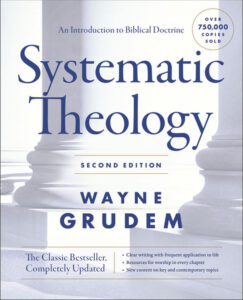 Zondervan recently published the second edition of Wayne Grudem’s Systematic Theology: An Introduction to Bible Doctrine. The first edition was published in 1994, and sold (according to the publisher) over 750,000 copies. This is a massive book of over 1,600 pages. Grudem, formerly of Trinity Evangelical Divinity School, is distinguished research professor of theology and biblical studies at Phoenix Seminary in Phoenix, Arizona, and author of many books. He holds degrees from Harvard, Westminster Seminary, and Cambridge.
 Since Grudem is a Baptist, Baptists in particular will want to read his chapters on church government and baptism. Back when I taught theology, I owned at least twenty books titled Systematic Theology. Which one is the best? Hard to say. Even though it is dated, I still recommend Lectures in Systematic Theology by Henry C. Thiessen (Eerdmans, 1949). It is Baptist, orthodox, dispensational, and premillennial. This was revised by Vernon D. Doerksen (Eerdmans, 1979), some of it rather extensively.