I received an e-mail recently from Notre Dame University Press informing me of a summer 40 percent off sale. Unlike some of the other e-mails I have received from publishers this month, there was no mention of Pride Month. However, one of the forthcoming books being promoted is Gay, Catholic, and American: My Legal Battle for Marriage Equality and Inclusion, by Greg Bourke, scheduled for release in September. Because Notre Dame is a Catholic university, it is to be expected that its press publishes books like Queen of Heaven: The Assumption and Coronation of the Virgin in Early Modern English Writing (2018), by Lilla Grindlay; and Mary’s Bodily Assumption (2014), by Matthew Levering. I reviewed another book of Levering, one that he wrote with evangelical Kevin J. Vanhoozer, Was the Reformation a Mistake? Why Catholic Doctrine Is Not Unbiblical (Zondervan, 2017), in the Spring 2018 issue of the Journal of the Grace Evangelical Society (pp. 103-106). But Notre Dame University Press also publishes hundreds of books that can broadly be considered religious that are not about Catholicism. The problem, however, is that the vast majority of them aren’t worth reading either.
 The only two books on my shelves published by Notre Dame University Press that I know I still have are The Sword of the Lord: Military Chaplains from the First to the Twenty-First Century (2004), edited by Doris L. Bergen; and St. Jerome’s Commentaries on Galatians, Titus, and Philemon (2010), translated by Thomas P. Scheck, Associate
 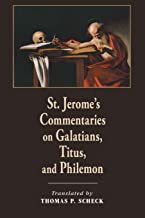 Professor of Theology at Ave Maria University in Florida, and a brilliant scholar. I also have Erasmus’s Life of Origen: A New Annotated Translation of the Prefaces to Erasmus of Rotterdam’s Edition of Origen’s Writings (1536), translated with commentary by Scheck (The Catholic University of America Press, 2016); and Origen’s Commentary on the Epistle to the Romans, translated by Scheck (The Catholic University of America Press, 2009, 2012). Notre Dame University Press also publishes Scheck’s Origen and the History of Justification: The Legacy of Origen’s Commentary on Romans (2016), but I haven’t gotten a copy yet. I did purchase and read Creation ex nihilo: Origins, Development, Contemporary Challenges (2017), edited by Gary A. Anderson and Markus Bockmuehl, soon after it was published, but it was a huge disappointment, so I got rid of it. Notre Dame University Press publishes The Study of the Bible in the Middle Ages (1989), by Beryl Smalley (1905-1984), but the copy I have is the 1952 second edition published by Basil Blackwell.
There are only two other religious books published by Notre Dame University Press that might be worth reading. First there is American Evangelicalism: George Marsden and the State of American Religious History (2014), edited by Darren Dochuk, Thomas S. Kidd, and Kurt W. Peterson. Marsden is the respected historian of American church history. I have his Reforming Fundamentalism: Fuller Seminary and the New Evangelicalism (Eerdmans, 1987), with an important new preface by the author; and his Understanding Fundamentalism and Evangelicalism (Eerdmans, 1991). I thought for sure I had his Fundamentalism and American Culture (2nd ed., Oxford, 2006), but can’t seem to find it. The second book is Hell: The Logic of Damnation (1992), by Jerry L. Walls, a Protestant scholar. I have his Heaven, Hell, and Purgatory: Rethinking the Things That Matter Most (Brazos Press, 2015), and his Purgatory: The Logic of Total Transformation (Oxford, 2012), but not his Heaven: The Logic of Eternal Joy (Oxford, 2002).
Regarding the non-religious titles published by Notre Dame University Press, I note that several volumes by Solzhenitsyn are available. If you don’t know who he is, then you should, and I suggest that you look him up. Statehood and Union: A History of the Northwest Ordinance (2019), by Peter S. Onuf, looks important to the study of American history, but is not high on my reading list. I was pleasantly surprised to see that Notre Dame publishes Twilight of the American Century (2018), by Andrew J. Bacevich.  Beginning with his The New American Militarism: How Americans Are Seduced by War (Oxford, 2005), which I think was his second book, and is one of his best, I have read almost everything he has written, and highly recommend all of his books. Rubbish or worthless is all I can say about the vast majority of the other non-religious books published by Notre Dame University Press.
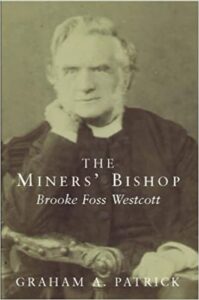 Brooke Foss Westcott (1825-1901) and Fenton John Anthony Hort (1828-1892), as I am sure most readers of The Preacher’s Library know, are the editors of a critical edition of the Greek New Testament (1881) that is the basis of the NA/UBS Greek text today and two of the translators of the New Testament (1881) of the Revised Version (1885). Together with Joseph Barber Lightfoot (1828-1889), they formed what was known as the Cambridge Triumvirate. Lightfoot was the most orthodox, Hort the least. Since most of what has been written about Westcott and Hort for the past 50 years has focused on the negative, I want to mention two books in my library
 about their life and work, written by British Methodist minister Graham A. Patrick, that are written from a neutral perspective: The Miner’s Bishop: Brooke Foss Westcott (OSL Publications, 2002; 2nd ed., Epworth Press, 2004) and F. J. A. Hort: Eminent Victorian (Almond Press, 1988). The first book is 282 pages, and focuses more on Westcott’s work. I must say that I had no idea that Westcott had fathered ten children, seven sons and three daughters. The work on Hort is more of a biography, but is only a brief 127 pages. While I don’t discount much of the negative press they have received, it is interesting to read a perspective not fueled by an agenda.
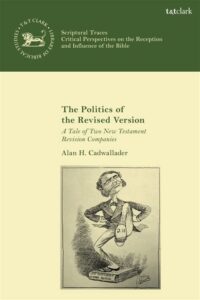 The first widely distributed and accepted modern version of the Bible was the Revised Version. The New Testament was issued first, in 1881, followed by the Old Testament with the New in 1885. Beginning with the publication of the New Testament, and continuing for several years, various books were issued in defense of the new Bible. Some of these touched on the history of the Revised Version, like Lectures on Bible Revision (Hodder & Stoughton, 1881), by Samuel Newth (1821-1898), one of the translators. If you are interested in a very scholarly, extremely detailed history of the translation of the Revised Version (written without an agenda), based in part on newly available material from the Westcott family archives, then The Politics of the Revised Version: A Tale of Two New Testament Revision Companies (T & T Clark, 2019) is your book. You can view the table of contents and the publisher’s description on the back cover